
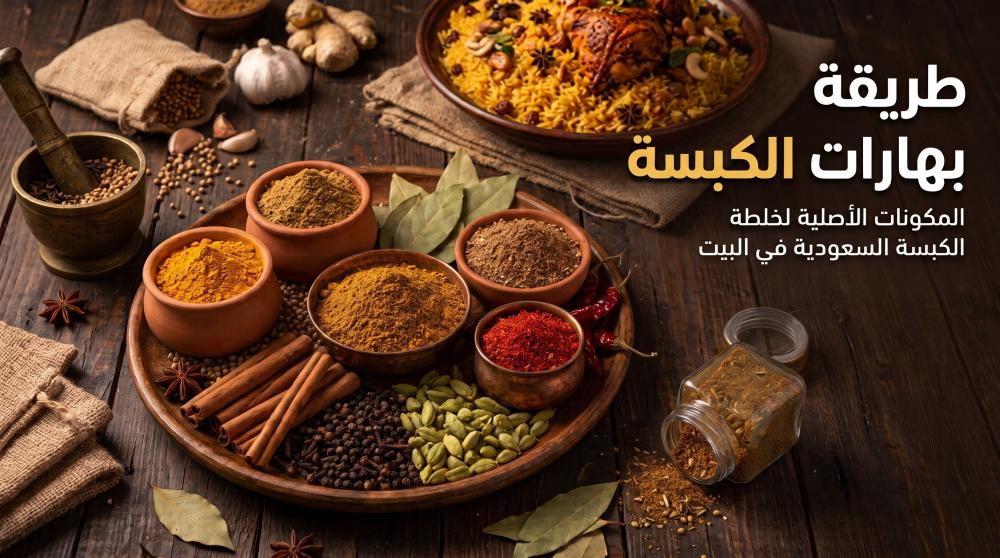

The aroma of Kabsa that fills the house before lunchtime doesn't come from the rice or the meat, but from the spice blend. That's why many people search for the correct Kabsa spice recipe , because the difference between a regular Kabsa and one everyone asks for again and again lies in the balance of the spices. In this guide, we explain the ingredients of Saudi Kabsa spice blends with their measurements, the difference between the spices for meat and chicken Kabsa, and how many tablespoons you need per cup of rice. If you prefer ready-made blends, you can find Sarra Kabsa spice blends and other mixes at Sarra Store .
What are the spices used in Kabsa?
Kabsa spice mix is a blend of ground spices that gives kabsa its warm aroma, golden color, and distinctive flavor. Its base consists of cardamom, cinnamon, cloves, cumin, coriander, and black pepper, with the proportions varying from house to house and region to region within the Kingdom. What distinguishes it from any other mix is the cardamom , which is the aroma that makes Saudi kabsa instantly recognizable. The fundamental principle is that no spice should overpower the others; rather, the mix should be balanced to create a harmonious and complete flavor.
The origin of Kabsa and its recipe
Kabsa is a popular dish in the Arabian Peninsula and is considered one of the most famous dishes in Saudi cuisine. It is said that its name comes from "kabs," meaning to place rice on top of meat and broth in a single pot and leave it to cook until it absorbs the flavors. With the arrival of Indian and Eastern spices via trade routes, cardamom, cinnamon, and cloves were added to the mix, becoming part of the dish's identity. This is why each region and each family has its own unique blend of spices.
Ingredients and quantities for Saudi Kabsa spices
This is a balanced mix sufficient for several dishes:
|Table|
Spice | Quantity | Its role in flavor
Ground cumin | 2 tablespoons | Warmth and depth
Ground coriander | 2 tablespoons | Mild herbal flavor
Black pepper | 1 tablespoon | Mild heat
Ground cardamom | 1 tablespoon | The distinctive aroma of Kabsa
Ground cinnamon | 1 teaspoon | Warm sweet
Ground cloves | Half a teaspoon | Strong depth in a small amount
Ground ginger | Half a teaspoon | Mild refreshment
Turmeric | Half a teaspoon | Golden color
Nutmeg | 1/4 teaspoon | Optional warming touch
|Table|
How to make Kabsa spices at home, step by step
- Choose fresh whole spices: cumin, coriander, cardamom, cloves and black pepper.
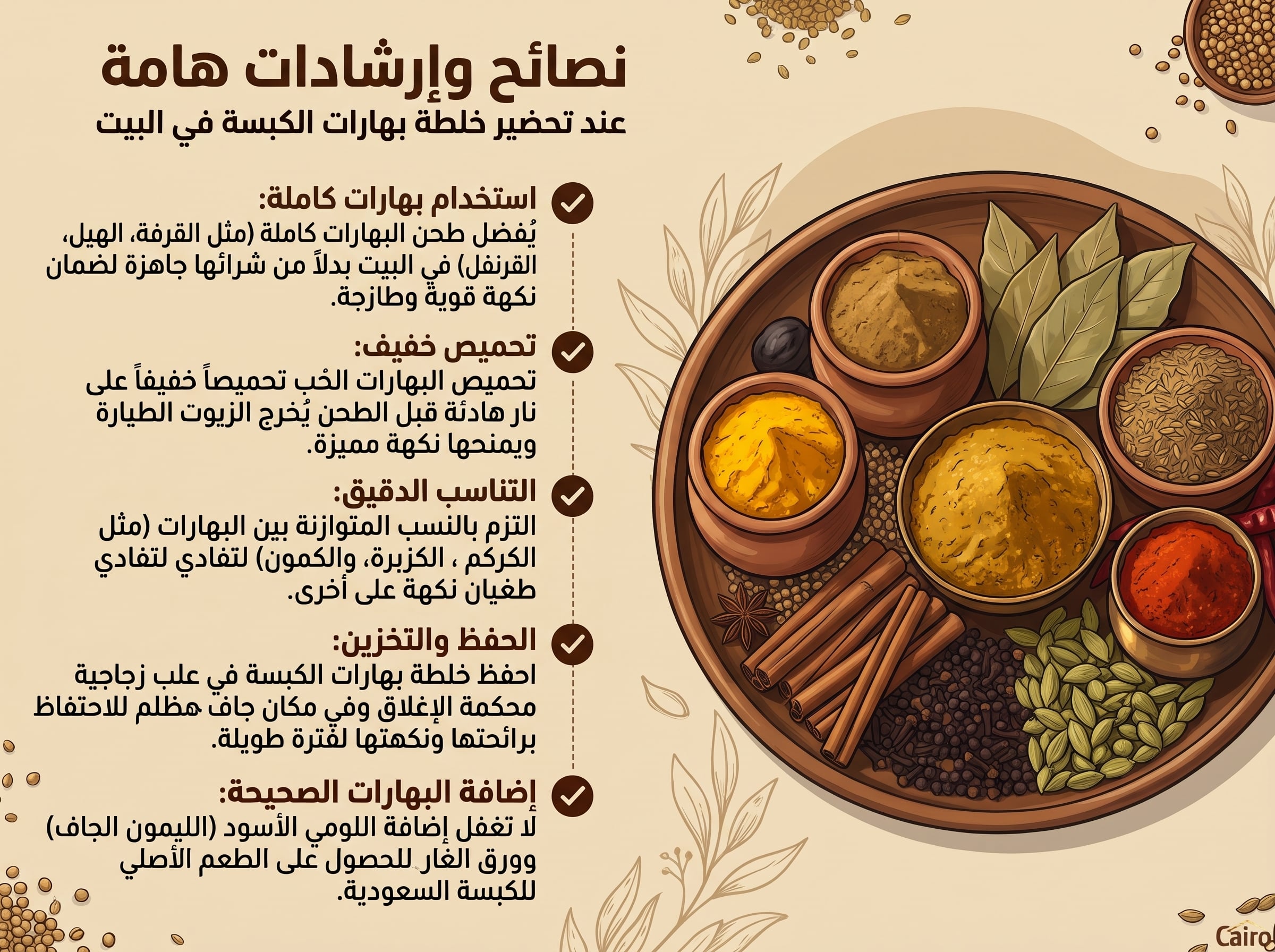
- Toast them in a dry pan over low heat for two minutes until they release their aroma, stirring continuously.
- Let it cool completely before grinding, because grinding it while it's hot will cause it to clump.
- Grind it finely , then add ground cinnamon, ginger and turmeric.
- Store it in an airtight glass jar away from light.
Roasting is the secret to the strong aroma, because it releases the aromatic oils from inside the bean.
The role of each spice in the flavor of Kabsa
- Cardamom: The one with the most famous aroma, and it is the first thing you smell when you open the pot.
- Cumin and coriander: the base of flavor upon which the taste is built.
- Cloves: very strong, one extra clove is enough to give a bitter taste.
- Cinnamon: A warm sweetness that balances the richness of the meat.
- Black pepper: Mild heat that opens up the flavor.
- Turmeric: for color only, and too much of it changes the taste.
- Loomi: It is not usually included in the ground mixture, but a whole loomi is added to the pot to give a slight acidity.
Meat Kabsa spices and chicken Kabsa spices
The spices for Kabsa with meat require a stronger flavor because the meat is heavier and cooks longer. Therefore, cardamom, cinnamon, and cloves are added slightly, and bay leaves and whole cardamom pods are added to the broth.
Chicken kabsa spices are milder, preferably including cumin, coriander, and turmeric, as chicken cooks quickly and is sensitive to strong spices. The chicken can be marinated before frying with a sachet chicken spice mix , then the kabsa spices are added to the broth.
Red Kabsa and its spices
Red Kabsa gets its color from tomatoes and tomato paste in larger quantities than regular Kabsa, and some households add paprika or chili pepper. The spices used are the same as for regular Kabsa, but with less turmeric because the red color comes from the tomatoes. The secret to its flavor is to sauté the tomato paste with the onions and spices for two minutes before adding the water; this reduces its acidity and results in a deeper, sweeter taste.
The difference between Kabsa, Mandi, and Bukhari spices
- Kabsa spices: They are mostly cardamom and cinnamon, and are cooked with rice in broth.
- Mandi spices: lighter and simpler, because the flavor of mandi comes mainly from slow cooking and smoking , not from an abundance of spices.
- The spices for Bukhari rice tend towards cumin and cardamom, and the dish is characterized by carrots, raisins, and a golden color.
Therefore, one mixture does not give the same result in all three dishes, and each dish has its own appropriate mixture.
The difference between Kabsa spices and mixed spices
Kabsa spices are specifically for rice and rice dishes, and cardamom is the dominant ingredient, giving Kabsa its distinctive aroma. Mixed spices , on the other hand, are a general blend for everyday cooking, suitable for broths, meats, sauces, and stuffed vegetables. You can use mixed spices in Kabsa when needed, but the result will be closer to the taste of everyday cooking than authentic Kabsa. In Surra, you'll find mixed spices in 80g and 200g packages , in addition to Kabsa spices .
How many tablespoons of spices for Kabsa per cup of rice?
These are guideline quantities; adjust them to your liking:
|Table|
Amount of rice | Kabsa spices | Approximately enough
2 cups | 2 teaspoons | Serves 3 to 4
3 cups | 1 tablespoon | Serves 5 to 6
4 cups | 1 1/2 tablespoons | Serves 7 to 8
5 cups | 2 tablespoons | Small portion
|Table|
Tip: For meat kabsa, increase the quantity by about a quarter. Taste the broth before adding the rice, as it's difficult to adjust the seasoning after the rice is cooked.
How to make chicken kabsa with kabsa spices
- Sauté a chopped onion in oil, then add garlic and a spoonful of Kabsa spices and stir for a minute until fragrant.
- Add the chicken and brown it on both sides, then add the chopped tomatoes and a spoonful of tomato paste.
- Add water along with two dried limes, bay leaves, and salt, and leave it until the chicken is cooked.
- Take out the chicken and brown it in the oven, and measure the broth: one and a half cups for every cup of rice.
- Add the rice that has been soaked for 30 minutes, and cover it over low heat until it is cooked.
- Serve the chicken on top of the rice, and sprinkle the sautéed mixture on top.
How to make meat kabsa step by step
- Sauté the onions in oil, then add the meat pieces and stir until they change color.
- Add the garlic, one and a half tablespoons of Kabsa spices , along with whole cardamom pods and a cinnamon stick.
- Add the tomatoes and tomato paste, then the hot water with the lime and bay leaf.
- Cook the meat over low heat for about an hour and a half until tender.
- Measure the broth and add the soaked rice, and leave it until it is cooked and absorbs the flavor.
Adding whole spices to the meat broth gives the Kabsa a deeper aroma.
Uses of Kabsa spices other than Kabsa
- Al-Muqalqal: A sprinkle of Kabsa spices gives the meat Al-Muqalqal a distinct Saudi flavor.
- Biryani and Bukhari rice: These can be used as a base with the addition of spices to each dish.
- Broths and soups: Half a teaspoon gives a warm depth.
- Barbecue marinade: With yogurt and garlic to marinate chicken and meat.
- Oven-baked potatoes: Sprinkle with olive oil before roasting.
Mistakes that spoil the flavor of Kabsa
- Adding more turmeric: It gives a strong color but changes the taste, as the color of Kabsa comes from the balance of spices.
- Adding spices over high heat: they burn and become bitter.
- Old spices: They lose their aromatic oils, so you need a larger quantity for a weaker result.
- Add more cloves: one extra clove is enough to control the taste.
- Not soaking the rice: it needs more broth and the grains come out broken.
- A little or a lot of broth: The rule is one and a half cups of broth for every cup of soaked basmati rice.
How to store Kabsa spices and how long they last
- A tightly sealed glass jar, away from sunlight, heat, and cooking steam.
- Write the grinding date on the jar.
- Ground spices retain their best aroma for several months, and whole spices last longer.
- Grind small quantities and replenish the mix instead of storing a large quantity.
- Do not use a wet spoon inside the jar so that it does not clump.
A sign that the mixture has expired is that its smell weakens when the jar is opened.
Ready-made Kabsa spices from Sarra
If you don't have time for roasting and grinding, these products from Sarra will save you time:
- Kabsa Spices 80g : A ready-made mix for Saudi Kabsa.
- Whole spices 250 grams : Spices for meat broth and rice.
- Chicken seasoning 80 grams : For seasoning chicken before frying.
- Kashna 250g : Fried onions ready to garnish Kabsa.
Browse all the mixes in the Spices and Seasonings section .
Why choose Surra spices for your Kabsa?
Sarra spices are 100% natural , carefully selected, and packaged in airtight containers to preserve their aroma. Our products are ISO certified for quality. From Kabsa to Muqalqal and broth, you'll find everything your Saudi kitchen needs in one place. Order now from Sarra Store , and for any inquiries , contact Sarra on WhatsApp .
Frequently asked questions about Kabsa spices
Questions
Q: What are the ingredients of Saudi Kabsa spices?
A: Cumin, coriander, black pepper, cardamom, cinnamon, and cloves, with a little ginger and turmeric. The proportions vary from house to house.
Q: How many spoonfuls of spices should I add to the Kabsa?
A: Approximately one teaspoon per cup of rice, i.e., one tablespoon for three cups, with a slight increase for meat kabsa.
Q: What is the difference between the spices for meat and chicken kabsa?
A: The spices for meat kabsa are stronger and include more cardamom, cinnamon, and cloves, while a lighter mix is suitable for chicken.
Q: Are the spices used in Kabsa the same as mixed spices?
A: No, Kabsa spices are specifically for rice and are predominantly cardamom, while the mixed spice is a general blend for everyday cooking.
Q: Should I add turmeric to the Kabsa spices?
A: In a very small quantity for color only, because adding more changes the taste of the Kabsa.
Q: Is dried lime one of the spices used in Kabsa?
A: Usually, a whole grain is added to the pot, and it is not ground with the mixture.
Q: Where does the red color of the kabsa come from?
A: From tomatoes and tomato paste sautéed with onions and spices before adding water.
Q: Should I roast the spices before grinding them?
A: Yes, roasting whole spices for two minutes over low heat strengthens their aroma.
Q: Why does Kabsa taste bitter?
A: Often due to the spices being burned over a high heat or an excess of cloves.
Q: How long does ground Kabsa spice last?
A: It retains its best aroma for several months if stored in an airtight jar away from light and heat.
|End|